
South Jordan Resident Directory Address Search
A known address is often the cleanest starting point. The Salt Lake County Assessor can return a parcel from a frontage number, street fragment, owner name, or parcel ID. The result is a tax and property record, not proof that a person sleeps there today. The Recorder then supplies the filed instruments that connect the parcel to grantors, grantees, legal descriptions, and dates. If the question is about one person, the South Jordan resident lookup sequence adds voter, court, vital, and historical checks without treating one match as final.
Use the narrowest source first. An address question belongs with the assessor, GIS, and Recorder. A current election registration question belongs with Utah Voter Search. A family-history question may begin with a directory, obituary, cemetery record, or archive index. Each result needs a source date, a record date, and a note about what it actually proves.
- Write down the exact South Jordan street address and ZIP shown by the source.
- Find the parcel and legal description in the county Assessor search.
- Check the Recorder for a dated instrument, then preserve its book, page, or entry.
- Use Utah Voter Search only when the name, birth date, and address are lawfully in hand.
- Move older or missing material to the library, archives, cemetery, museum, or a focused GRAMA request.
Note: A public record can be a useful lead without being a complete resident list or proof of current occupancy.
South Jordan Records Offices
South Jordan records sit across city, county, and state custodians. The Salt Lake County Assessor and Recorder are at 2001 S State Street in Salt Lake City, while the County Clerk’s Elections Division uses the same county address. South Jordan City Hall, the city recorder, the GIS and CityView systems, the Memorial Park, Gale Museum, Utah Courts, and county vital-record offices fill different gaps. No one office keeps a complete directory of everyone in the city.
Salt Lake County Recorder
2001 S State Street N1-600
Salt Lake City, UT 84190
385-468-8145
Salt Lake County Assessor
2001 S State Street
Salt Lake City, UT 84190
385-468-8000
County Clerk Elections
2001 S State Street S1-200
Salt Lake City, UT 84190
385-468-7400
For city-held material, South Jordan City Hall is at 1600 W Towne Center Drive, South Jordan, UT 84095, with the general city number 801-446-HELP. The city’s public-records page routes requests under the Utah Government Records Access and Management Act, known as GRAMA. A request should name the department, describe an existing record, and include a useful date range, address, case number, or person name.
Search South Jordan Residents by Assessor
The Salt Lake County Assessor detailed query is one of the most useful current South Jordan resident-record tools because it can be approached from a person, a street, or a parcel. Owner names use the format “Last Name, First Name,” with at least the first three letters. Street searches can use a frontage number, a partial street name, a directional, or a type. Parcel IDs can be searched as a base number with an optional encumbrance suffix.
| Owner name | At least three letters, usually Last Name, First Name. |
|---|---|
| Frontage Number | Street number, alone or with a street name. |
| Street Name or Number | Partial or like values can start a street search. |
| Parcel ID | First 10 digits, optional last four for an encumbrance; first seven can return a block. |
| Controls | Search, Reset, classic page, and printable version. |
The displayed owner, situs address, mailing address, and legal description may not agree. A company, trust, or estate can be the owner label. Treat the parcel card as the bridge to the Recorder, not as a conclusion about the household.
See the official Assessor query before reading the captured fields.
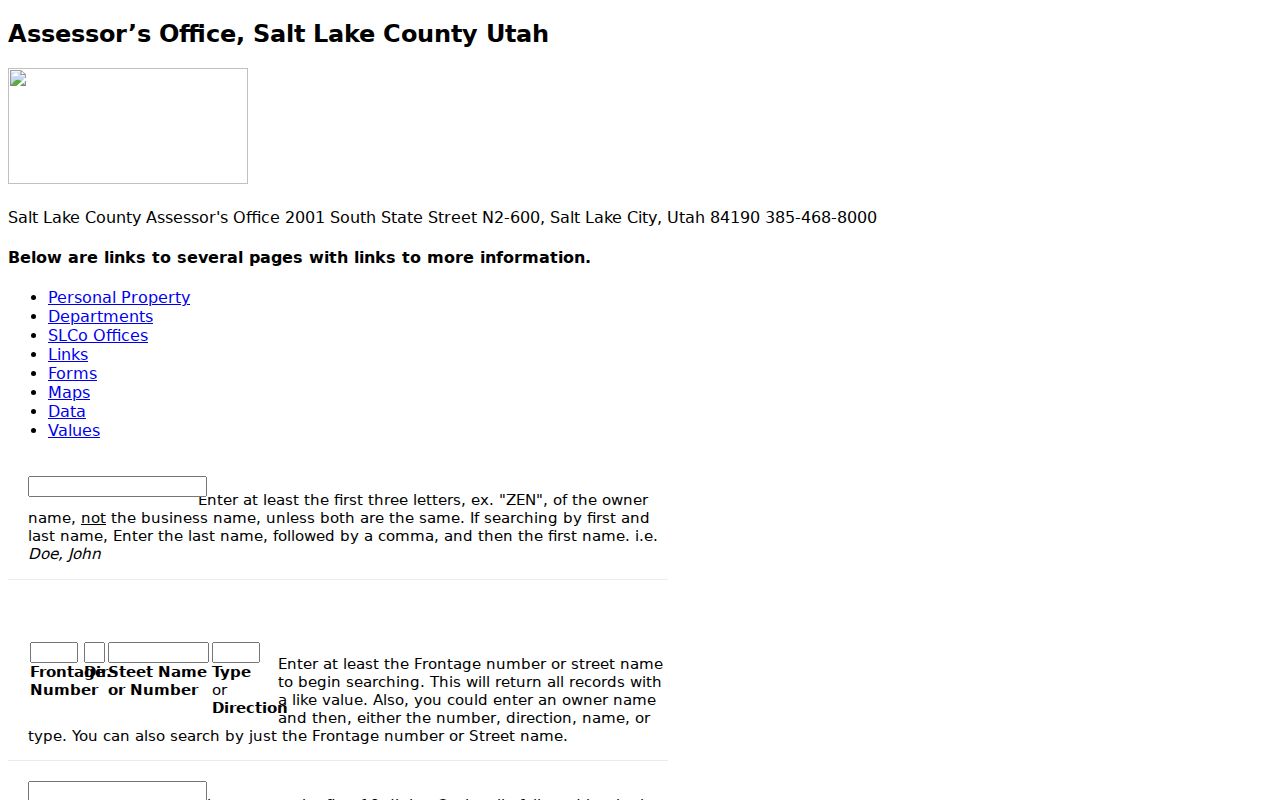
The captured Assessor screen shows why a street search should preserve the portal’s field names. Record the parcel ID and address exactly before moving into GIS or deed research.
Follow South Jordan Directory Parcels Into Deeds
The Recorder’s public search is a parcel and document locator. It asks the user to choose an address or parcel from an auto-populated list and accept its terms. The property information may be at least a day old, and the search is not a title opinion. Deeper Data Services access is paid, with a $5 24-hour login and separate unit charges for searches, pages, plats, maps, and record images.
Online material reaches Book 262, page 1, Entry 899028, recorded March 1, 1941. The Recorder describes an ongoing digitization goal toward 1850, but older coverage is not guaranteed. The index vocabulary includes GRANT, WD, QCD, MTGE, RECON, LIEN, JUDG, PLAT, SUB TR, EASEMT, TRUST, DEATHC, DIVORC, DEDIC, RESTRICT, ROW, VACATE, SATIS, RELEASE, and AFFID. Those labels can reveal a transfer, subdivision, trust, estate, easement, or release without making every entry look like a sale.
Open the official Recorder search to compare its locator with the image below.
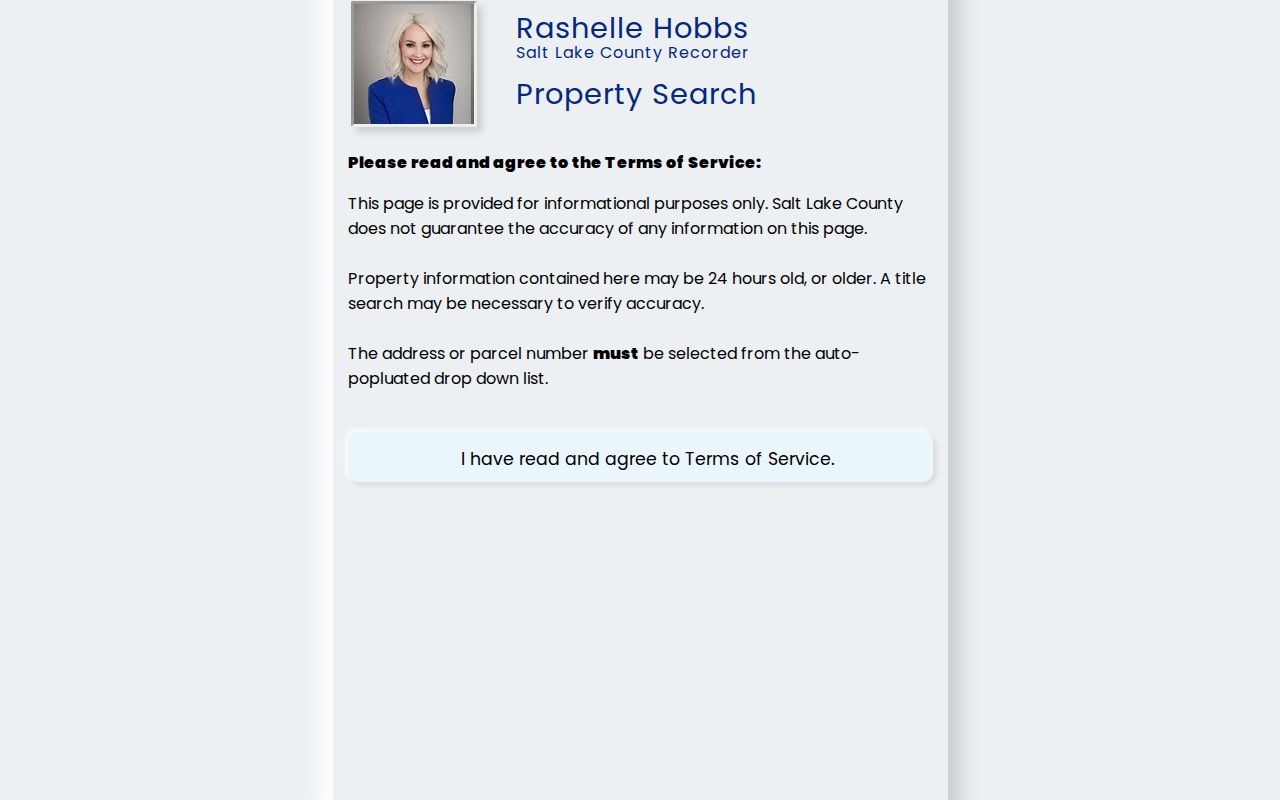
The deed-index image pairs well with the parcel search. For an older South Jordan address, retain the legal description and instrument date because a street label may change while the parcel identity remains usable.
South Jordan’s Current Directory Sources
Several official systems look like directories but answer different questions. The table keeps those roles separate. It also shows why a name search may need a second record before it can be understood.
| Source | Who or what appears | Keeper | Access |
|---|---|---|---|
| Property card | Owner label, situs, parcel, tax detail | Salt Lake County Assessor | Free online |
| Recorded index | Grantors, grantees, instruments, dates | Salt Lake County Recorder | Public locator, paid depth |
| Voter lookup | Name and address match, current registration result | Utah Elections | Individual search |
| CityView and GIS | Parcels, permits, code and civic geography | South Jordan | Map and portal |
| Cemetery data | Interment and disinterment names | South Jordan Memorial Park | Interactive data |
City meeting records, board appointments, public comments, and the city staff directory can place a person in a civic event without proving city residence. CityView can route a property, permit, engineering, planning, or code question, but its dynamic fields and access rules vary by department.
What South Jordan Voter Records Reveal
The Utah Voter Search is a narrow current check. Its fields are First Name, Last Name, Date of Birth, Street Address, City, and Zip. A South Jordan search may use 84095 or 84009 as the address record shows. The result helps test a name and address combination, but it is not a historic roll or a full count of residents.
Public voter products can expose name, physical and mailing address, age range, party, and vote history. Date of birth, ID numbers, Social Security number, email, phone, and signature are protected. At-risk records can be anonymized or withheld. For area research, the state’s paid voter file includes precinct and district fields, but a block-level article should use boundaries and aggregates rather than print a roster.
Courts, Vital Records, and Names
Utah Courts Xchange can show public party names, court location, case type, case number, filing date, case history, and available documents. Search scope can be district, justice, both, statewide, county, or court. South Jordan matters need current routing because South Jordan Justice Court closes July 1, 2026, with prior and new matters moving to Salt Lake County Justice Court. Xchange searches cost $0.20 and documents cost $1 through the online service; courthouse terminals and the Utah State Law Library offer free access points.
Salt Lake County Vital Records handles certified Utah birth and death certificates and marriage or divorce abstracts. Birth records become public after 100 years, death records after 50, and marriage or divorce abstracts after 75. Recent copies require the subject or an eligible relationship, identification, and relationship proof as applicable. A vital record confirms a stated event, not a current address.
South Jordan ZIP Directory Snapshot
South Jordan is served mainly by ZIP Codes 84095 and 84009. Utah’s Geospatial Resource Center describes ZIP polygons as approximate postal delivery areas, not city or parcel boundaries. The 84009 ZIP began July 1, 2015, west of Bangerter Highway, and 84095 remained accepted during a one-year transition. A directory or deed letter before that change may print 84095 for a location now written 84009.
Keep the city label, ZIP, parcel, precinct, and district as separate fields. South Jordan GIS places ZIP, parcel, subdivision, flood, zoning, future-use, Daybreak, and city-boundary layers together. Exact delivery should be checked through USPS or the source’s address record, not inferred from a colored polygon.
South Jordan Historical Resident Directories
The University of Utah Marriott Digital Library holds a 1869 Salt Lake Valley directory, an 1894–95 R.L. Polk volume, and suburban Polk titles for 1966–70 and 1972–74 that name South Jordan among the included communities. Salt Lake County Archives reports city directories from 1958–1983 and some later volumes through 1999. The Utah Historical Society and Salt Lake City Public Library add maps, clippings, newspapers, microfilm, photographs, and local-history material.
South Jordan Memorial Park’s Names in Stone data records interments and disinterments. The Gale Museum at 10300 S Beckstead Lane is a free local-history resource with collections on the 1892 Schoolhouse, Beckstead Farmhouse, mining and community, and the area’s development. The first located cemetery interment is John A. Bills on September 9, 1863. These are valuable family-history leads, not a complete list of former residents.
Visit the official South Jordan committees page for the civic directory shown here.

The city’s committees and boards page is a public civic directory. It can identify participation in the Arts Council, Youth Council, Planning Commission, or other groups, while keeping civic activity distinct from a residence claim.
South Jordan Resident-Record Terms
Four terms help keep a South Jordan residents directory search honest. A roll is a list maintained for a defined purpose, such as elections or taxation. An index points to a record and may not include its full image. A criss-cross directory reverses a printed name list into street order. A parcel is the county property unit tied to a legal description, not a list of everyone living there.
- Roll
- A maintained list for a stated program or civic task.
- Index
- A finding aid with names, dates, types, or identifiers.
- Criss-cross directory
- A reverse address section used to connect a street to a printed occupant entry.
- Parcel
- A mapped property unit with an assessor ID and legal description.
A name in the assessor can be an owner account. A directory name can be an occupant. A court party can have an address from the filing date. A cemetery name can show a burial connection. The safest reading keeps each fact inside its record’s purpose.
South Jordan Public-Record Fallbacks
South Jordan’s public-records page and GRAMA form are the city fallback for an existing permit, code, police, meeting, or municipal record. The city normally describes a 10-business-day response, or five business days for a qualifying public-benefit request, with copies at 25 cents per page and other format or service charges where allowed. The form asks for contact details, department, record description, date range, and requested response. Some Police, Fire, or Medical requests can require ID or authorization documents.
Salt Lake County accepts GRAMA requests online, by email, mail, or in person. Ask for inspection or copies, give a reasonable description, and request a fee estimate for a large search. For older property material, use the Recorder counter and copy request, County Archives, Utah State Archives, Marriott, UHS, or library microfilm. The Recorder lists ordinary copies at $2 per page, historic copies at $5 per page, and a $5 certification charge in addition to certified-copy page fees.
Use the official South Jordan GRAMA form as the request starting point shown below.
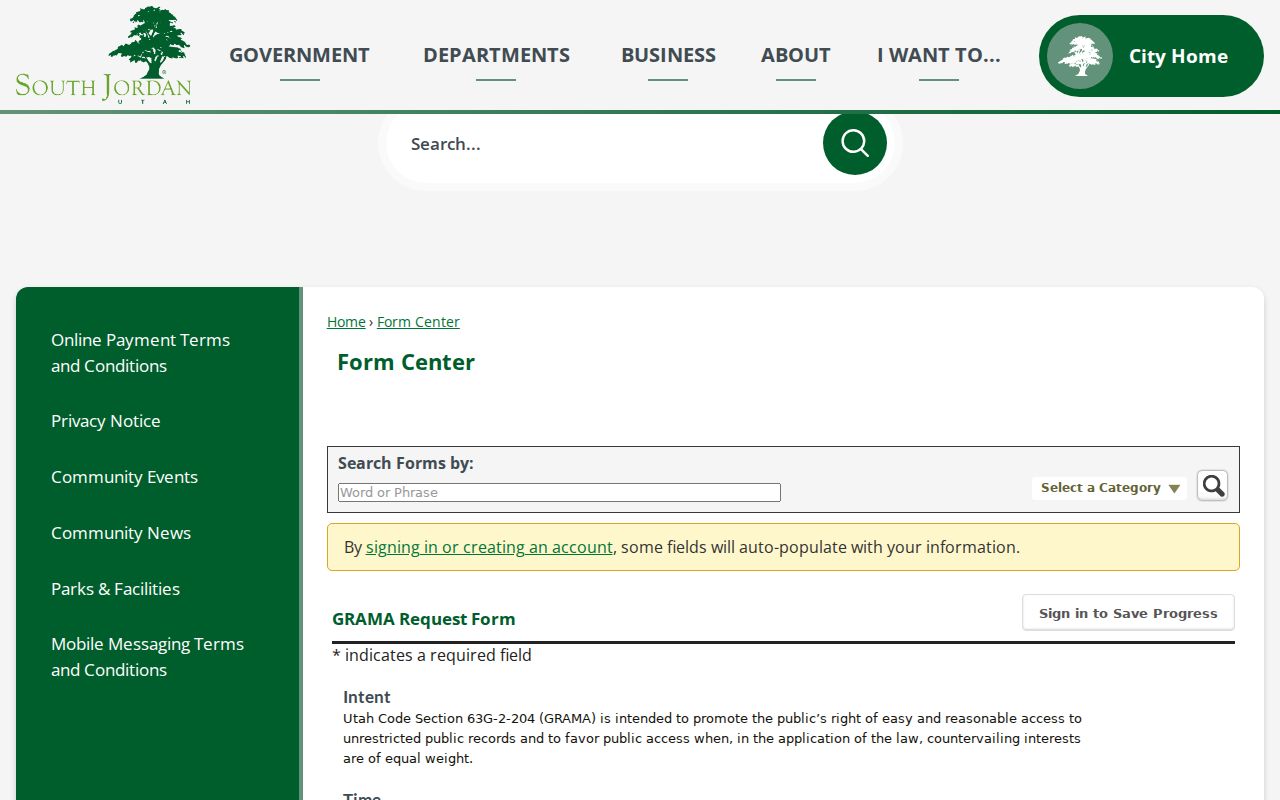
The GRAMA form capture shows why a focused request is better than asking a custodian to create a new resident list. Name the existing record and the department that created it.
South Jordan Resident Privacy
Utah GRAMA classifies records as public, private, controlled, protected, or restricted. Public access does not make every field fit for republication. Court systems limit sealed, expunged, juvenile, child-welfare, and other private matters. Voter products omit protected identity fields and may conceal at-risk voters. Utah Safe at Home provides eligible participants with a substitute address and mail forwarding, so a researcher must never join that substitute address to a physical parcel.
Lawful personal use. Use South Jordan records for a lawful personal purpose, family history, civic research, or property understanding. Never use a public address to stalk, harass, threaten, or harm another person.
Commercial data brokers may copy or combine public material, but an opt-out does not erase the county record, court file, voter record, or archive. For a correction or restricted record, contact the custodian named by the source. Keep only the information needed for the research question.
South Jordan’s Record Story
South Jordan’s growth makes the layers especially visible. Census QuickFacts reports 50,418 people in 2010, 77,487 in 2020, and a 2025 estimate of 87,614 across 22.19 square miles. Those figures describe population, not searchable names. The city’s older Gale history, its 1892 schoolhouse, its former agricultural valley, and the newer Daybreak and I-15 areas all leave different kinds of records.
Recent changes matter. South Jordan Justice Court’s July 1, 2026 closure changes where cases are routed. The Recorder is shifting mapping services toward Parcel Fabric and Data Services. UGRC updated west-side ZIP polygons in November 2025. The Gale Museum refreshed its name and exhibits in 2024. Check the live office page before relying on an older address, fee, map, or portal.
For the complete historical shelf, use the South Jordan directory book page. For one name, compare these sources through the resident lookup, and stop when the public record becomes protected or the evidence no longer supports the claim.